The antimeme is the message of the medium

The antimeme of the antimeme no longer exists.
(Fair warning: today’s topic lends itself to McLuhanesque pronouncements. And I have a weakness for McLuhanesque pronouncements.)
I mean that the idea of “antimeme” was once an antimeme but has now, in certain spaces, become a meme. Nadia Asparouhova recently published Antimemetics: Why Some Ideas Resist Spreading, as part of the Dark Forest Collective on Metalabel, itself an initiative I fully endorse. The meme of the antimeme spreads as in the form of a review essay in the New Yorker by the always excellent Gideon Lewis-Kraus.1 I’m not going to rehash either of these; assuming you know what memes are, the one-sentence summary is that antimemes are “ideas that resist being remembered, comprehended, or engaged with, despite their significance.”
Antimemetics is billed as the “first nonfiction book exploring the phenomenon of antimimetics”; the nonfiction caveat is essential because of the exceedingly internet-forward text There Is No Antimimetics Division (TINAD) by qntm. This Wikipedia page is a good primer on the sprawling, collaborative hypertextual world in which TINAD is set. Anyone despairing of the death of the novel needs to dip their toe in the SCP archives.2 TINAD is a cult classic, a classic antimeme. The reason that the idea of the antimeme has become a meme is that the book and the New Yorker essay are more memetic textual modalities than is the sprawling, collaborative hypertextual world.
Asparouhova leans on the (decreasingly but still) dominant Silicon Valley network-science framework to define the context in which certain memes or antimemes are more or less successful, explicitly invoking relevant scientific equations. The structure of the social graph and the vulnerability/resistance of individual nodes determine the breadth and speed of spread.
That’s true as far as it goes. But the value of Asparouhova’s thesis would be enhanced by engaging with media theory. This is generally true for the Rationalist/Bay Area/Tech writing scene of which she is a part. I engage with this scene a lot, I find them useful on many topics — but I find them extremely unappreciative of medium-is-the-message style arguments. Although self-critical to a fault, they are all too happy to retain the mistaken belief that information is virtual rather than physical.
To apply my argument reflexively, this is because the medium of communication for this scene is virtual text; more specifically, the kind of reading and writing that happens with a computer. This reading and writing breaks the linearity of the medium of printed text in a number of ways. Embedded hyperlinks change the flow of the text, allowing it to spill outwards indefinitely. Copy+pasting makes perfect reproduction more natural. Collaborative writing explodes the myth of the individual author. Live webhosting makes the text infinitely mutable. And the instanteneity speeds up all of the feedback loops.
As a result, media theory is an antimeme for this scene, built around this communication modality. They think that ideas are real, but not physical; ideas are words on a screen, and the screen is just a liquid portal to the Platonic realm. Memes are ideas, and the Rationalist project is devoted to understanding and combating human cognitive biases that limit our ability to perfectly see through this liquid portal and inject these ideas into our minds.
The antimeme is the message of the medium, defined negatively.
We can identify what the medium is telling us by observing what it is unable to tell us.3
We can also try to define the message of the medium positively, but not exhuastively, by identifying the memes which spread within it. Thought experiments are a prominent case. Roko’s Basilisk, the Repugnant Conclusion, the Drowning Child, and, of course, the Simulation Argument…thought experiments are powerful memes for a community built on a maximally virtual, minimally embodied medium of communication.4
Wordy, philosophically dense thought experiments are the main memes of this community. It is, then, plausible to identify memes with ideas, as Asparouhova does and as Lewis-Kraus accepts. The problem with this account, from the perspective of the average internet user, is that that’s obviously not what memes are.
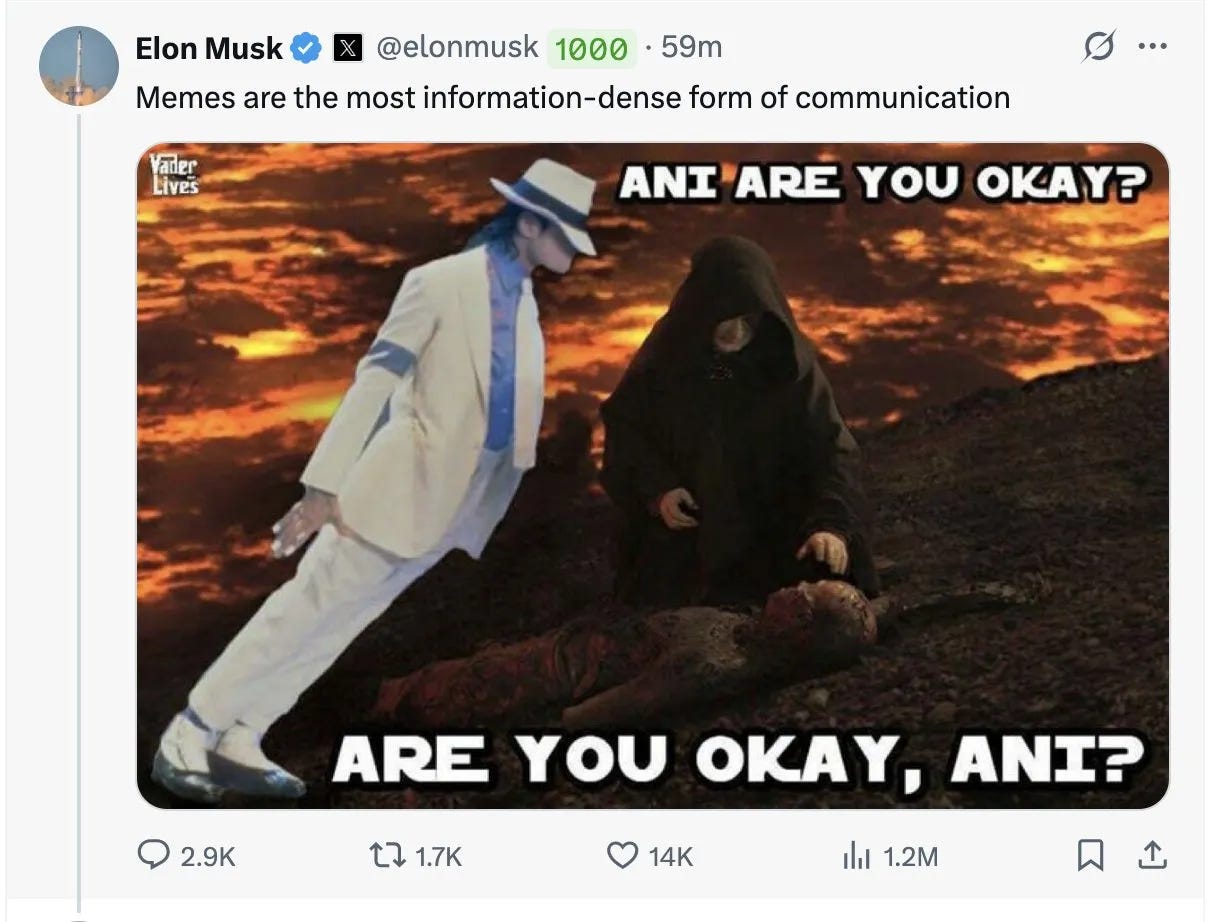
The Poster has identified an ideal-typical meme: a digital image with superimposed text. The meme is pure surface, defined recursively — but usually not that recursively. This produces the illusion of depth.
Memes, in general, are only defined with respect to the medium in which they are stored and communicated. As the dominate mode of communication has, over the past 15 years, become digital images, we have enstablished the canonical “meme” as a digital image, one which roughly fills the space of a smartphone screen.
The Poster’s claim is obviously stupid, from a variety of information theory perspectives. The linked meme is just a pun, there are only two relevant bits of information here despite the image file taking up 947kb.
If I don’t “get it” — if my prior information set doesn’t include Michael Jackson or Star Wars — the informational content of the meme is zero, it’s indistinguishable from pure noise.
But…I’m most interested in why the tweet is stupid from a phenomenological perspective. We need move away from the abstract/virtual world where information is only something that we take in through our eyes and maybe ears, sitting by ourselves in front of a screen. If we treat ourselves as artificial beings embedded in a low-dimensional landscape of pixels, as game- and information-theoretic agents engaged in stimulus-response or at best strategic/computational optimization, we ignore the fact that we are bodies.
We are human bodies, our phenomenology is distinct from that of our phones, as I described in iPhoneomonology. The “densest” form of communication would be something that involves our entire sensorium. If we restrict ourselves to one or two information channels, we’re obviously taking in less information.
Humans are quite plastic; our sensory apparatus changes based on the communication environment in which we are raised.5 But we’re not infinitely plastic. The information-density frontier must involve all of our senses, telling us something about what the human is, what evolution has designed us for. When are our senses most heigtened? When the stakes are high and we are physically engaged with many other people. Team sports. The high school dance. The street protest. The memes in these context are physical processes using all of our sensory inputs to react to the behaviors of many other people simultaneously.
So, The Poster is correct that the meme is (potentially) the densest form of communication within the degraded artificial space of a feed-based social media platform. But these platforms’ antimemes are the embodied, social processes that cannot be encoded as digital media, and they are far more information dense than anything that happen on a screen.
In the next post, I will make the argument that cybernetics (and, earlier process philosophy) is the antimeme at the heart of Western philosophy—which is axiomatically communicated through the medium of books and pdfs.

I’m glad to see the following passage in Lewis-Kraus’s account presented so matter-of-factly:
After 2016, many liberals were inclined to diagnose the pathologies of the internet as a problem of supply. Some people have bad ideas and beliefs…The solution was to limit the presence of these bad actors, to cut off the supply at the source…The major weakness of this account was that it tended to sidestep the question of demand.
I’ve spent much of the post-2016 era arguing precisely for the centrality of demand-side explanations for online political phenomena, both on this blog and in my published academic work. To me, this explanation has become obvious to the point of tautology…so it’s great to see it presented as such in a venue like the New Yorker.
The novel is indeed dying but literary fiction is thriving. Fetishizing the aesthetics of the novel is already a bit twee and seems to be becoming reactionary. Discussions about the state of the contemporary “internet novel” are making a category mistake if they think the “internet novel” has anything to do with Penguin Random House; the real “internet novel” is, like TINAD, a novel, on the internet. Sorry, folks, this is what happens when we revolutionize communication technology.
Perhaps it’s useful to think about media-theoretic antimemes as an application of Godel’s first incompleteness theorem, which says that “that no consistent system of axioms whose theorems can be listed by an effective procedure (i.e. an algorithm) is capable of proving all truths about the arithmetic of natural numbers.” For a given set of axioms, which are the unprovable truths?
Intriguing possibility: Asparouhova begins the book by discussing her aphantasia, “the inability to visualize things in one’s mind.” The concept was formally defined in 2015, and is already a huge hit in this Rationalist/Bay Area/Tech writing scene. Perhaps aphantasia (or some other cluster of cognitive traits?) is part of an explanation for their resistance? I prefer the media-technology explanation but gene-environment interactions rule the day.
McLuhan emphasizes that different communication technologies shift the ratio of information we get from our different senses; the most famous example, described by McLuhan and his student Walter Ong, is the shift from “tribal” oral culture to “modern” literary culture. More information comes from our eyes than our ears, re-arranging our sensorium.
I'm so glad you discussed this book, as I've been hearing a lot about it lately (anti-antimetically, I suppose), and wanted to check it out. It would be interesting to hear more thoughts on the book itself; especially, what the implications would be any failure to engage with media theory and the tendency to equate memes/antimemes with ideas, while ignoring phenomenology and embodiment. How should this alter our conclusions? Would it imply, for instance, that antimemetic patterns in face-to-face, IRL communication are just as influential as the ones emphasized in the book? Or, that antimemetics as a theory becomes incoherent if we take all media formats (not just virtual screens) into account?
I'm no expert on that Rationalist tech scene, but one striking feature is a certain ahistorical mindset and absence of humanities influences; pro-reason, but simultaneously anti-intellectual. A lot of media theory is not worlds apart from critical theory and those Continental traditions. You sometimes get the sense that people in those circles aren't so aware of older thinkers or theoretical lineages, and are attempting to engage with many of the same issues but with a presentist (or futurist) bent.
the antimeme seems like it might be related to the "negative template", a construction from Peter Dale Scott which I always use professionally when reading government communication. Asking yourself the question "what is the important thing which might have been naturally mentioned here, but which is not?" is often the key to understanding such texts.