Protocol Politics

Metascience is my bag. Meta-science can just means applying scientific methods to studying science — and the dominant form of metascience is thus unsurprisingly isomorphic to the dominant form of social science, that is, positivist, ontologically incurious and supremely self-confident. But meta- just means above, taking a step back rather than being immersed in. We can take that step to whichever vantage point offers the most pleasing view.
From the persepective of meta-science as the art of science, then, I found the view of electromagnetically modified two-headed worms most pleasing, indeed.
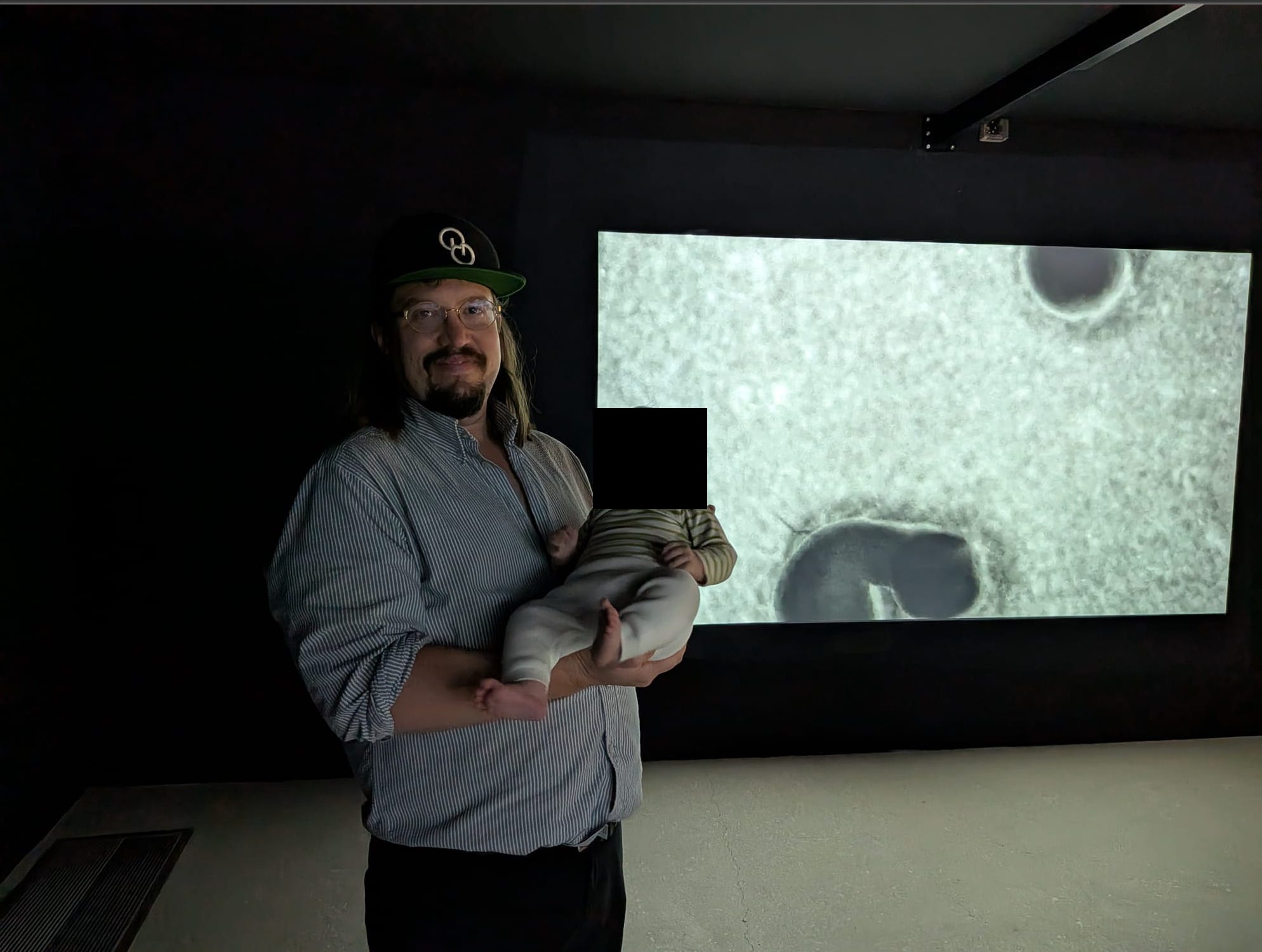
The worms were on display at the Palazzo Diedo in Venice, as part of the Strange Rules exhibition promoting and implementing the concept of protocol art. From what I gathered, the electromagnetic manipulation in the developmental stage of the worm causes the second head to grow — but more astonishing, the worms’ offspring also grow a second head. Common Lamarck W, the kids will say, vitalism mogs. And that’s true. But the key meta-scientific move is to foreground the protocol that produced and will continue to produce two-headed worms, not the worms themselves.
Of course, I’m mostly interested in what the worm protocol tells us about the internet. In a recent interview of Adam Curtis for VICE1, Dean Kissick passes on the following observation.
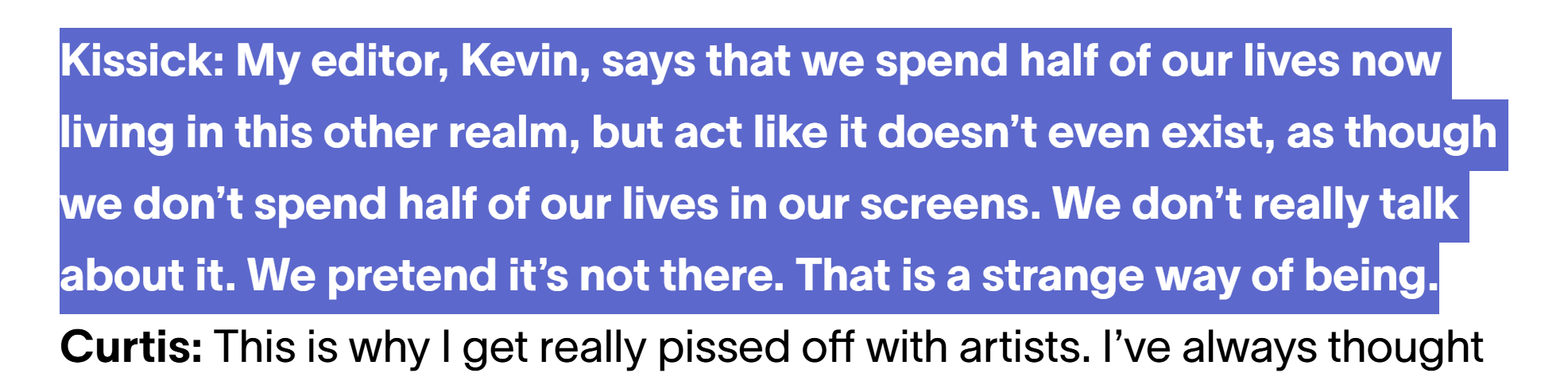
Kevin (no relation) is right. And Adam Curtis is right to be pissed off with artitsts, too, though he should make an exception for my friends Joshua Citarella and New Models, in general but also specifically for their Palazzo Diedo art piece The Online Marketplace of Ideas, a merch show gallery installation that lays bare the protocol powering politics in the platform age.
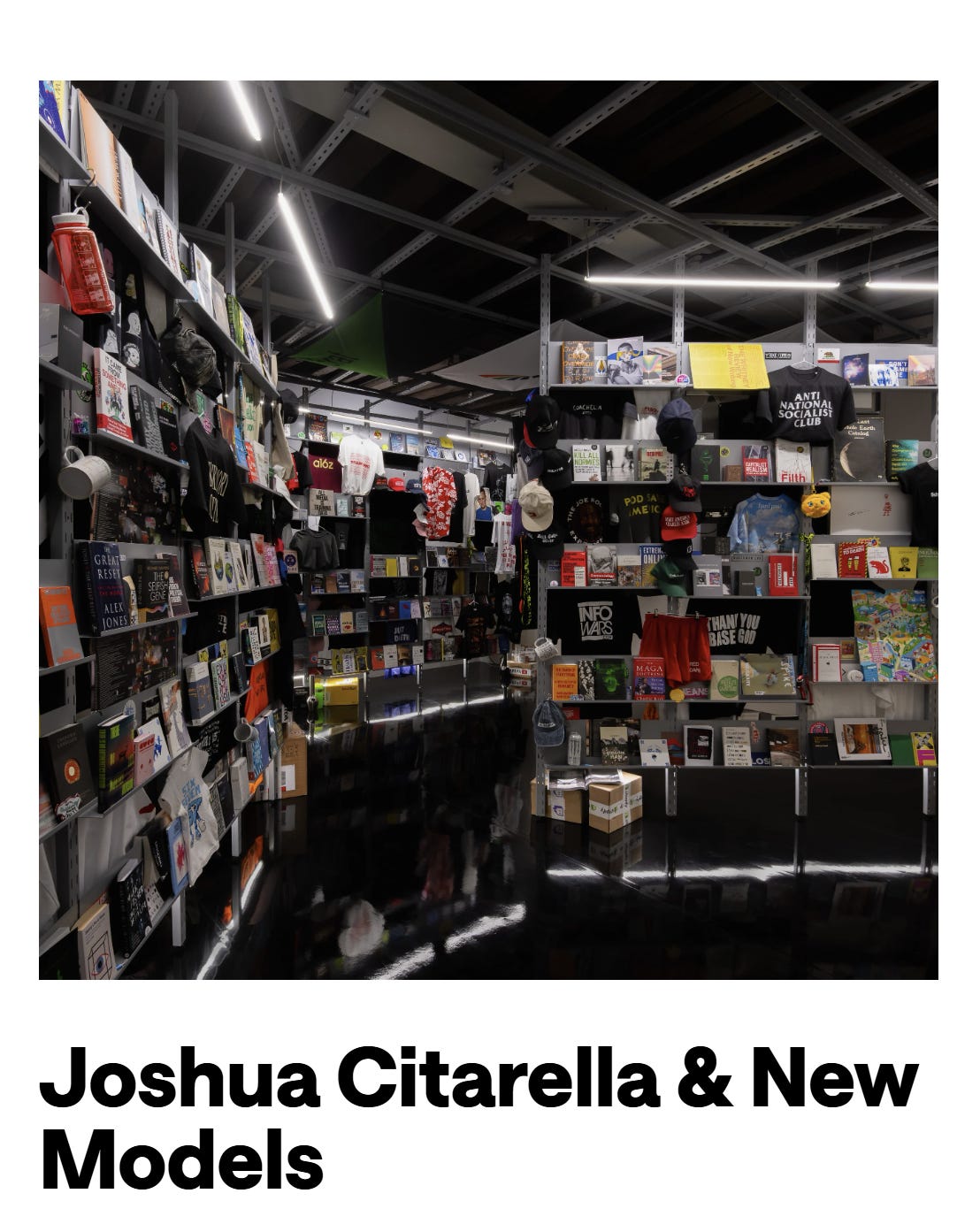
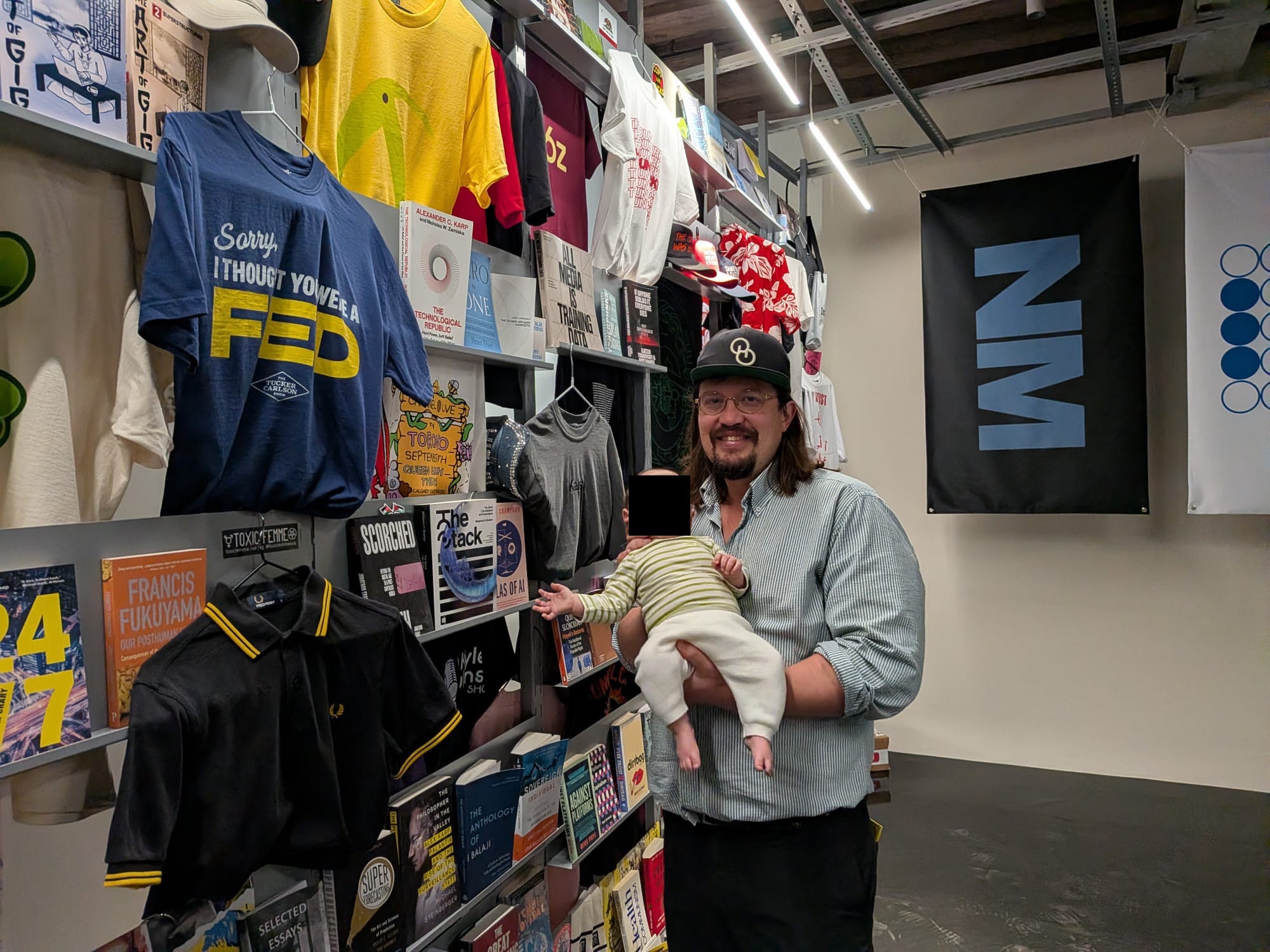
The exhibit was jarring, very unlike any experience I’ve had at a capital A-art gallery or musuem. The objects were mostly recognizable, it was obvious that they should exist since I’ve seen them online, but they simply should not have been able to exist together. Each signifier can be incorporated into mainstream culture, either through endorsement or exclusion; indeed, the protocol of postwar American extended through the platform internet actively encourages the emergence of distinct identities and the products you can buy to inhabit them.

It was jarring to see my book Generation Gap with Nick Land’s Fanged Noumena and a pair of Red Scare booty shorts, a juxtaposition I never thought I’d encouter outside the “special” compartment under my bed. But while it was fun to play, “ooh, I know that one!”, the gestalt experience was the art: the fact that all of these objects, though signifying or even embodying radically different ideologies, are in fact the product of the same protocol.
We’ve certainly read articles about how dangerous Infowars is, or you can buy an Inforwars t-shirt. You can dress up like a Boogaloo Boy in an oversized Hawaiian button-down; you can drink white Monster and become a body without (functional) organs. Obviously, Trump and the MAGA hat is the single biggest winner from this protocol, such a massive cultural embedding that the legacy establishment has re-defined as nothing more than MAGA’s negation.
But the overwhelming mass of these objects, their collective weight, is far too large to be incorporated or even comprehended by the dwindling center. Kissick, in the same interview, says that “not just the art world, but a lot of the cultural establishment, a lot of the media has pivoted to upholding the illusion of normalcy,” while Curtis nods in agreement. The illusion of normalcy is shattered by the encounter
I’ve called this “Boomer Realism,” and downstream of the outsized demographic/economic/institutional and therefore cultural power of that generation. Their premisese are the ones that are still operative because nothing else has succeeded in establishing alternative premises that stick. Obviously the world is fragmenting, but by its nature fragmentation is harder to comprehend than is cohesion. There might be many smaller worlds breaking off, but the Boomer world is still the largest one left; the centripital desire for normalcy is keeping it alive even longer than the material conditions would predict.
The Online Marketplace of Ideas is a Frankenstein’s monster of stitched-together political-cultural artifacts, looming over the shrinking iceberg of Boomer political-cultural normalcy. The past decade has been frothy, a cambrian explosion of post-neoliberal ideologies each trapped in their own whirlpools. The eddies are visible — and in some cases, if the media or political establishment wants to pin something radical on their mainstream opponents, they can become major discursive currents of their own. But without the point of view like that offered by this exhibit, it’s easy to think that the mainstream is still more powerful than the uncountably many Charybdes2 waiting the in the coves and inlets.
So what does one do with this? What is “protocol politics”? Protocol politics is about widening the whirlpool, tying together (live)streams of thought, using the tools of It’s not quite the same thing as “meta-politics”, which is really just the politics of politics. The media world that my readers likely inhabit is full of meta-politics, primarily in the form of pundits and posters debating what the Democratic (or Labour) party should be doing in order to appeal to other people. This is a debilititating ironic distance from the actual experience of politics; this entire class of hypereducated media consumers cannot do politics per se. They’re taking the protocol as given, just trying to optimize it.
Protocol politics is different. Flusser speaks of this, in Into the Universe of Technical Images:
Present-day revolutionaries know that they first have to build a consensus. Their action is not against images but against the current feedback consensus between images and people.
Nate and Nate and Matt and Noah and Ezra and the rest of the liberal meta-politics guys accept the “feedback consensus” between images and people — they understand their goal as simply to identify the correct images that will produce the desired feedback. The goal is to optimize or even micro-target “political messaging,” a behavioralist fixation of control. But this misunderstands the nature of the apparatus, of our technical society. Old liberal/literary forms are untenable, but we haven’t woken up to that fact; the progressive intellectual elite attends to “political consciousness vegetating in an artificially preserved republic” (in Flusser’s terms) for themselves, and fine-tuned (ahem) messaging for the masses.
Even from a narrow, cynical perspective, this approach is self-defeating. Left-liberal politics cannot succeed in an atomized, dispersed society. And yet atomization is the message of this medium, the product of this protocol. This is one of the defining facts of today, that we’re all scrolling alone. Flusser, again from 1989:
the way telematic gadgets are used now, to produce empty chatter and twaddle on a global scale, a flood of banal technical images, definitively cements in place all
the gaps between isolated, distracted, key-pressing human beings.
And none of the individualized radical media products on offer can overcome this protocol; in fact, they only intensify it.
The people that are shouting and sounding alarms today, the Che Guevaras and Khomeinis, and those who count as revolutionaries are really entertainers. They
are spectacular, and the spectacle they present assists the images in dispersing us more and more effectively. They are spectacular, and the spectacle they present assists the images in dispersing us more and more effectively.
It’s like Alex Jones read Flusser as a how-to guide.
So what’s the alternative? Joshua Citeralla’s Doomscroll podcast project is one example. The structure of the podcast is conversations about politics; on a content level, unremarkable. But the protocol is to develop a media brand that enables a dialogue between media figures and politicians across the entire broad swath of what could be considered “the left.” This is the same playbook used by alt-right and other figures in the broader constellation of anti-establishment, anti-liberal media entreprenuers of the 2010s, except that they didn’t understand what they were doing—it’s just that their ideological inclinations converged with the protocol:
The structure of a society governed by technical images is therefore fascist, not for any ideological reason but for technical reasons. As technical images presently function, they lead on their own to a fascistic society.
Genuinely democratic collective governance is both incredibly difficult and the only solution. We live in the universe of the technical image. The challenge of protocol politics is how to build new pathways to share these images on our own terms rather than accept the paltforms we’re given — and to cultivate new subjectivities that understand how to relate to them.
Which by the way VICE is back, but now it’s headquartered in London, so it’s pronounced VOYCE.
I just looked this up, Charybdis (not Scylla) is the whirlpool one, and that’s how one would spell the plural of Charybdis.
Protocol politics sounds cognitivly effortful. Would it work on with lazy audiences