
Christmas came early: the Pew Research Center just dropped their bi-annual Americans’ Social Media Use Report, for 2025. For a decade, this has been the best source of data on trends in social media adoption.
Topline data shows that use of the big three platforms has pretty much plateaued, and that TikTok continues to grow at roughly the same rate as Instagram did during its expansion.
(Note that this analyzes adults, so no data on under-18s, and that this is done via carefully executed surveys, so bots and non-representative respondents aren’t a concern.1 Also note that this is people who ever use each platform — this isn’t saying anything about the intensity/duration of usage).
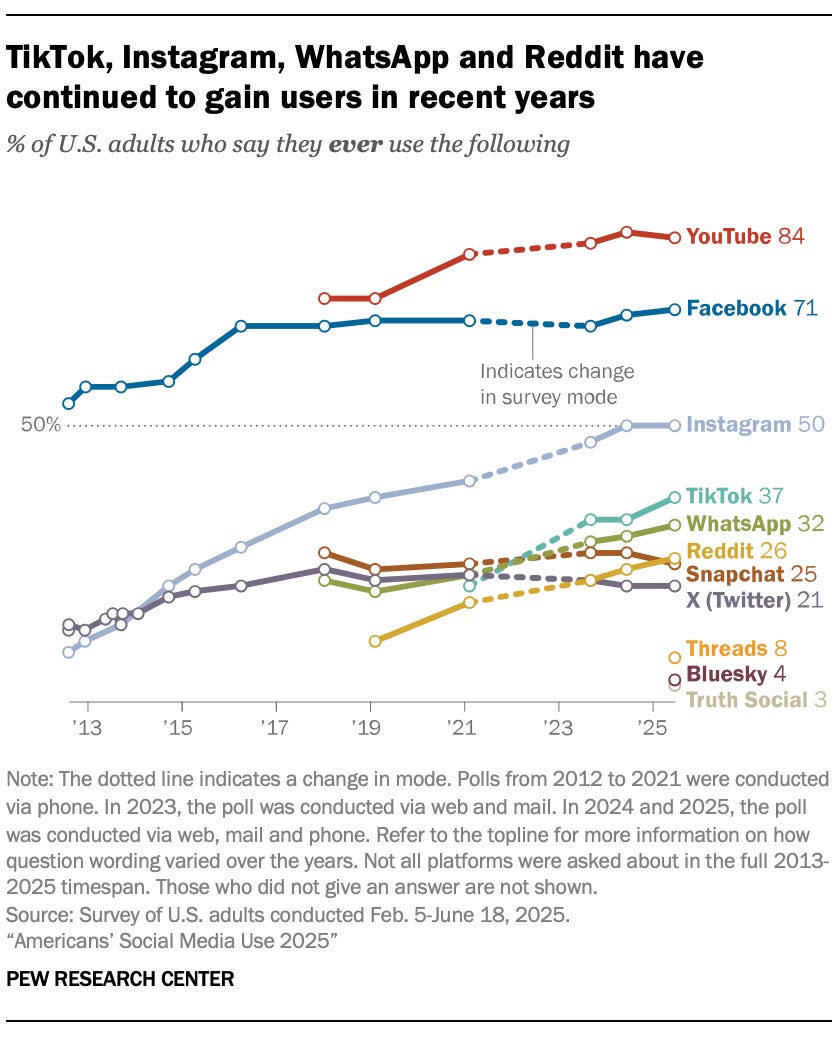
The most surprising development, to me, is the rapid expansion of Reddit usage — it basically doubled from 2019 to 2025. After like fifteen years of casual scrolling, I finally and definitively kicked my Reddit habit last year, so I don’t really know how the platform experience has changed, but it’s definitely unusual for a platform to have persisted for so long in a given niche and only now, twenty years after it was founded, reach a quarter of the US adult population. We’ll discuss this in a bit.
Given the attention dynamics online, of course, the headlines derived from this Pew report focus on the status of Elon Musk’s platform. Usage of Twitter peaked at 24% of US adults in 2018, had been pretty much constant since then, with a small dip to 21% in the 2025 report. The tech press saw this as a win.
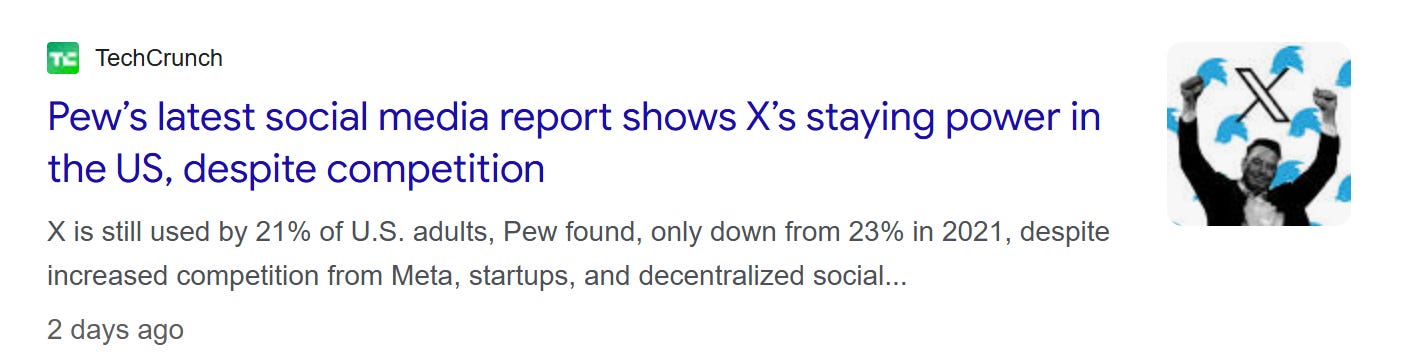
the XX-odus
But these topline numbers fail to capture the piece of evidence in the title of this article: X is now the most male-dominated social media platform in the US. I scraped the gender usage data from the time series of Pew Reports and calculated the gender ratio for each platform in each year, and X in 2025 has a male-female imbalance which is less extreme only than late-2010s Reddit.
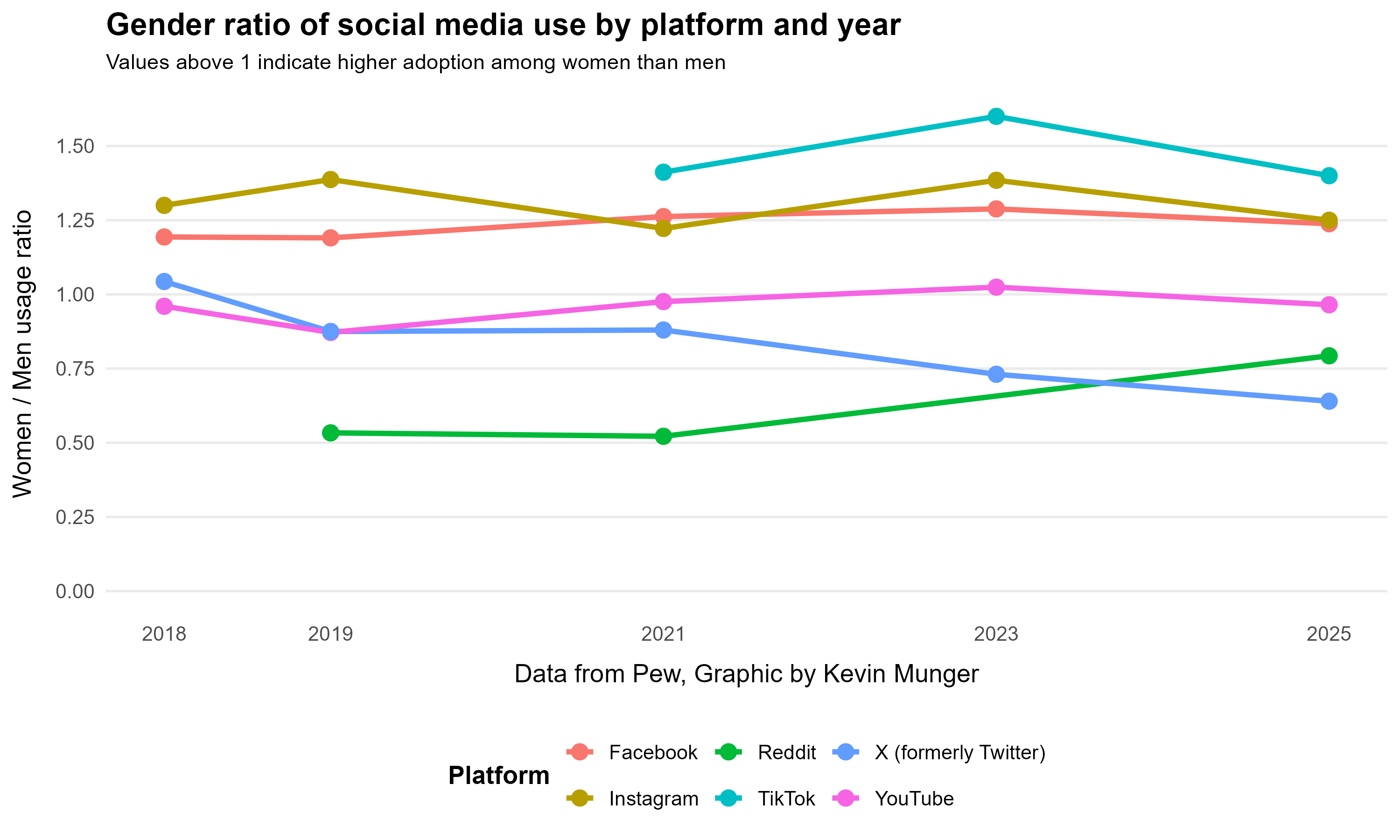
YouTube is used by essentially everyone, so there’s no gender gap; Facebook and Instagram have a moderate but stable imbalance in favor of women; TikTok is actually the most gender-imbalanced platform, with about 50% more usage among women than men, but again this imbalance is stable.2
The real action comes from Reddit and X. We see now that the former’s overall growth was driven primarily by increasing usage among women, bringing Reddit much closer to gender parity. In contrast, where Twitter use was equal in 2018 and slightly favored men from 2019 to 2021, the Elon Musk era has seen a steady erosion of female participation. Never in the history of modern social media has one gender so decisely abandoned a platform.
Why does this matter? Aside from explaining a lot about the vibes on X, I’m increasingly convinced that gender polarization, especially among young people, is both:
Upstream of contemporary ideological developments, on both “the left” and “the right”3
Driven by gender fragmentation in online spaces
Most young people really don’t care about politics, but they do care, a lot, about gender, romance, sex. The less they’re learning about and experiencing this offline, the more intense things get online — and this is a feedback loop, where these online conversations are driven by the most gender-embittered individuals who spend the most time online, developing narratives and explanations for how and why the world is conspiring against their gender. Political “entrepreneurs”4 then come along and coalesce these greiveances into (psuedo)-ideological frameworks which then, potentially, interact with electoral politics.
I recently cohosted (with my colleague Léa Pessin) an interdisciplinary workshop at EUI about youth gender polarization and internet fragmentation; we’re working on writing up the results, but we’re convinced that this is a major new socio-political trend that academics should be paying attention to.
What I really want to avoid is an analysis of “the Manosphere” that is a reprisal of the way that internet scholars in the late 2010s studied “the alt-right,” as a simple contagion of evil that must be surveilled and quarantined. As academics, we need to understand the underlying dynamics that give rise to these trends; we’re the only actors in society with the remit to do so.
More broadly, “the Manosphere” has for years been much too large for this strategy to be successful, even for political activists. There is no way to build a successful political coalition that writes off a huge chunk of the population, especially if they are young and not yet fully politicized.
And so as always I think that the first step is to develop a robust quantitative description of who is using different platforms and for what. That X is now the most male-dominated social media platform in the US is one small but important fact upon which I hope to continue to build a more comprehensive understasnding.
(Sorry this post was so breezy and fun; the next one will not be, don’t worry.)
Ok, non-representativeness is technically alwasy a problem, but Pew is the gold standard here…in light of recent politicization, I might trust these surveys more than the census…
Among platforms with more than 20% total usage, I dropped LinkedIn bc it was boring and WhatsApp/SnapChat because the overall gender ratio isn’t very relevant for how those platforms are used. In the 2010s, Pew asked about Pinterest, which was WAY more gender imbalanced than anything today, but it looks like that platform has mostly fallen off so I dropped it as well.
Scare quotes here because the whole point of this ideological re-alignment is that existing categories don’t really make sense. The
In classic American fashion, the line between entrepreneur and grifter is thin indeed.
A clue to Reddit’s resurgence might be: as Google search results have been overwhelmed with bots and fake AI-generated sites, Reddit has become a much better way to get a narrowly focused human opinion on something. When in a new city I’d go to Reddit to answer “where should I eat” bc for whatever reason it’s easy to jump over the bot posts on r/charlotte and get to the real local opinions.
Maybe it’s conscious design of the mod system, or just their algorithms being less sophisticated.
I note that Reddit has now started shoving AI summaries into results - where all useful context that helped you assess the credentials of the poster are stripped away.
I view this as a sort of Schelling neighborhood segregation, but on the internet. It's more comfortable to hang out with people who share your values and assumptions. Especially when likes/upvotes/etc. reward cloistering with the like-minded. People gradually drift out of online communities which make them uncomfortable, and into communities which feel cozy.
As an example, I used to like reddit for its thoughtful intellectual discussion. But as the years pass it has increasingly turned into a gigantic, mindless scoldfest for midwits. Why bother? X users may be crass, but at least they aren't self-righteously smug.
On the other hand, I can see how certain Karen-type women thrive in the reddit environment. The more Karens reddit acquires, the more hospitable it becomes to Karens. The downvote button makes it easier for them to stamp out any trace of independent thought. Downvotes make reddit work distinctly different from any other internet platform.